A new business case published by the United Nations Population Fund Asia and the Pacific Regional Office (UNFPA APRO) is strengthening the evidence for investment in workplace health – drawing on the experience of Samsung Electronics Viet Nam Thai Nguyen (SEVT) and the work of MSI Reproductive Choices Viet Nam.
From training on sexual and reproductive health to mobile healthcare services
Since 2022, MSI Viet Nam has partnered with Samsung Electronics Viet Nam Thai Nguyen (SEVT) to strengthen workplace health support for employees. SEVT is one of Samsung group’s largest mobile manufacturing facility with around 30,000 employees.
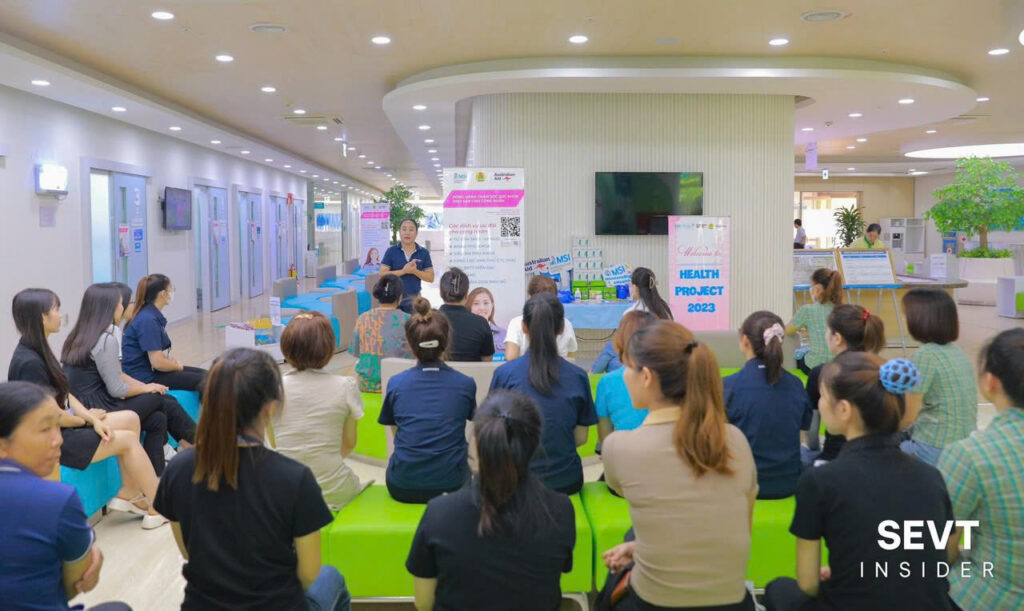
The collaboration began with training and had since expanded to include service delivery. MSI Viet Nam now trains factory health staff and employees including production-line leaders, department heads and other staff who regularly interact with workers on sexual and reproductive health, mental health, workplace violence and harassment, and related topics.
MSI Viet Nam also provides scheduled mobile healthcare services at the factory, including consultation and counselling, gynaecological examinations and screening, family planning methods, follow-up advice and referrals where needed.
Between 2023 and 2026, MSI Viet Nam’s workplace health interventions reached nearly 10,000 workers.
Building the case for investment
The newly published business case, The Business Case for Sexual and Reproductive Health Programmes in the Workplace, examines existing workplace health programs at SEVT and uses UNFPA’s Return-on-Investment Tool to estimate their potential impact on key business outcomes.
The analysis estimates that workplace health interventions of the kinds examined could potentially contribute to:
- productivity increases of 5–15%
- reductions in absenteeism of 1.4–25%
- reductions in staff turnover of up to 6%
These figures are modelled estimates based on existing academic and scientific research, rather than measured changes at SEVT.
The significance of the business case lies in what it enables: a stronger evidence base for conversations with employers about why investing in workers’ health – particularly women’s health – can matter not only for employee wellbeing, but also for workforce participation, retention and productivity.
MSI Viet Nam’s role
The business case was commissioned by UNFPA Asia and the Pacific Regional Office, with Good Business Lab leading the technical analysis using UNFPA’s ROI methodology.
MSI Viet Nam played a key role in supporting the development of the Viet Nam case.
The team facilitated coordination between SEVT, UNFPA APRO and Good Business Lab; supported SEVT to provide the required anonymised administrative data; helped explain the operational context of SEVT’s workplace health program and MSI Viet Nam’s service-delivery model and the business case publication.
From evidence to advocacy
For MSI Viet Nam, publication of the business case is a starting point for the next phase of the work.
The team plans to use the findings to inform communications and advocacy with factories, brands and other businesses, with the aim of encouraging greater investment in the health and wellbeing of workers, particularly women.
This creates an opportunity to take the experience from one workplace and use it to support broader private-sector engagement.
As MSI Viet Nam’s RESPOND Project Manager Le Thi Kim Yen explains:
“The findings from this business case are compelling and practical. They provide solid evidence for developing a communications and advocacy strategy to engage factories, brands and other businesses in investing in the health and wellbeing of workers – particularly women – and show why workplace healthcare matters both for people and for businesses.”
The business case also reflects a broader lesson: workplace health programs can be more than an employee benefit. When designed well, they can help reduce barriers to healthcare, strengthen women’s access to information and services, and contribute to healthier, more inclusive workplaces.
Read the full business case on the UNFPA Asia and the Pacific website.
MSI’s work in Viet Nam is supported by the Australian Government through the Australian NGO Cooperation (ANCP) Program. Find out more here.